Lennox-Gastaut syndrome prognosis
 Reviewed by
Lennox-Gastaut syndrome (LGS) is a severe, lifelong form of epilepsy that typically begins in early childhood. Because seizure patterns and care needs evolve over time, effective seizure management is essential to supporting cognitive function, mood, and overall quality of life throughout a person’s lifespan.
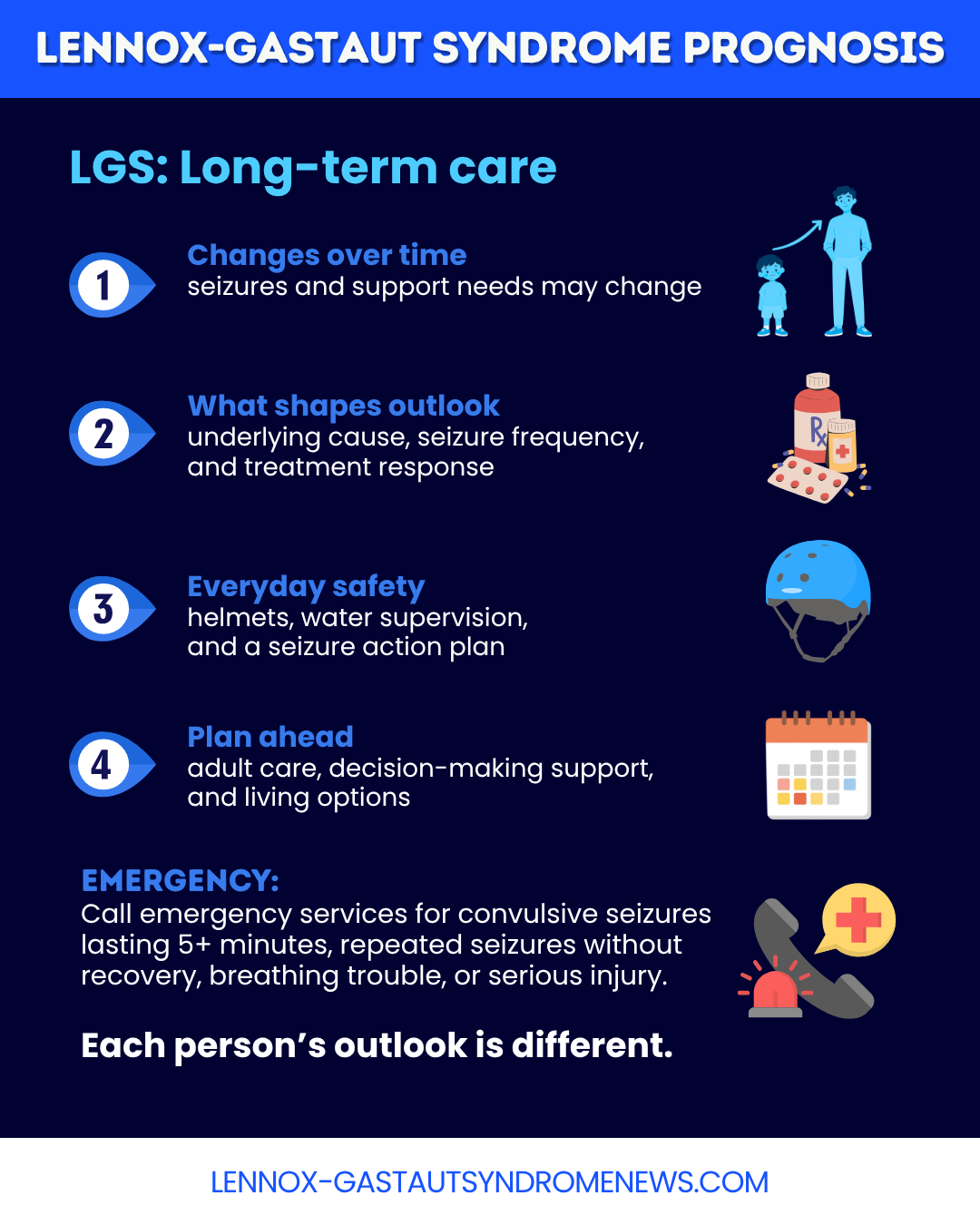
Long-term outlook and disease progression
In most cases, symptoms such as difficult-to-control seizures and learning difficulties continue into adulthood.
LGS seizure evolution means that seizure types and patterns can change over time. In childhood, the main seizure types are:
- tonic seizures, which involve sudden stiffening, often during sleep
- atypical absence seizures, which may involve staring spells
- atonic or drop seizures
Seizure patterns vary considerably among individuals. Tonic seizures, particularly during sleep, often persist into adulthood, while atypical absence and atonic seizures may become less prominent. Focal seizures, which start in one brain area, and tonic-clonic seizures, which involve whole-body convulsions, can also occur.
To track and evaluate these evolving seizure types, clinicians rely on electroencephalograms (EEGs), which record the brain’s electrical activity. In LGS, characteristic patterns include generalized slow spike-and-wave discharges and generalized paroxysmal fast activity, which appear as bursts of fast brain wave activity during sleep. These patterns may become less apparent with age, although fast activity during sleep often persists. The absence of these patterns on a later EEG does not rule out an established LGS diagnosis.
LGS progression varies greatly from person to person. Developmental difficulties and LGS cognitive impairment commonly occur, but ongoing cognitive decline is not inevitable. Some people develop skills slowly or stop gaining skills temporarily, while others lose abilities or continue making steady gains.
Outcomes depend on the underlying cause, associated neurological conditions, overall seizure burden, and treatment response. Hyperactivity, aggression, and sleep problems also frequently occur.
Life expectancy and mortality risks
Many people with LGS live into adulthood, with some living into their 50s or beyond. Although LGS life expectancy is generally reduced, individual outlook depends on seizure control, underlying causes, and other health conditions.
Sudden unexpected death in epilepsy (SUDEP) is a potential risk. Across epilepsy populations, frequent tonic-clonic seizures represent the strongest established risk factor. Seizures during sleep and longer epilepsy duration also increase this risk.
While individuals with LGS often carry these risk factors, current evidence does not show SUDEP to be the leading cause of death in LGS, and the exact condition-specific risk remains under study. Because drug-resistant (refractory) epilepsy requires careful management, families should discuss individualized risk profiles directly with specialists.
Beyond SUDEP, other notable risks include falls and aspiration pneumonia, a lung infection caused by inhaling saliva, food, liquids, or stomach contents. Aspiration can occur during seizures or because of chronic swallowing difficulties. Prolonged seizures, respiratory complications, physical injuries, drowning, and underlying medical conditions also contribute to mortality risks.
Key factors influencing individual prognosis
Long-term outcomes in LGS depend on the underlying cause, baseline developmental functioning, associated neurological disabilities, seizure severity, and treatment response:
- Underlying cause: LGS can result from brain injury, brain malformations, infections, or genetic changes. If testing identifies a single seizure-producing brain area that doctors can safely treat, surgery may offer a viable option.
- Age at onset: Seizures usually start between ages 3 and 5. Earlier onset sometimes correlates with greater developmental challenges, but age alone does not reliably predict long-term outcomes.
- Seizure frequency and control: In a study of adults with LGS, frequent seizures correlated with greater difficulty managing daily activities and functioning independently.
Scroll horizontally to view all columns -->
| Factor | Associated with better outcomes | Associated with poorer outcomes |
|---|---|---|
| Underlying cause | An identifiable seizure focus may allow surgery | Causes associated with substantial neurological impairment may increase support needs |
| Age at onset | Later onset may be associated with fewer developmental difficulties | Earlier onset may be associated with greater difficulties, depending on other factors |
| Seizure frequency and control | Better-controlled seizures are linked to better functioning | Frequent or difficult-to-control seizures are linked to poorer functioning |
| Development and neurological functioning | Stronger baseline skills and fewer associated disabilities may support functioning | Developmental difficulties and neurological disabilities may increase support needs |
Understanding these individual prognostic factors often requires identifying the root cause of the syndrome. In modern epilepsy management, genetic testing plays an important role in evaluating LGS and other drug-resistant epilepsies, particularly when the root cause remains unclear. A genetic diagnosis helps clarify prognosis, guide treatment choices, and inform genetic counseling.
For specific underlying conditions, testing identifies targeted treatments or clinical trials for emerging precision medicine or disease-modifying therapies. These specialized options are not available for every cause, so specialists can advise families on testing and re-evaluating earlier genetic results.
Transitioning to adulthood
LGS in adulthood usually involves ongoing care and support. Most adults need help with daily activities and cannot live fully independently.
Transition planning should start during adolescence, involving the person with LGS, family members, healthcare professionals, and school staff. Planning covers specialized epilepsy care, medication management, behavioral support, rehabilitation, caregiver needs, community resources, funding, and long-term living arrangements. Guardianship, supported decision-making, and residential plans must reflect individual abilities and needs. Residential care waiting lists run long, making early planning essential.
Beyond administrative and residential planning, ongoing clinical management in adulthood must adapt to changing physical and pharmacological needs. Mobility and swallowing difficulties may emerge or worsen, sometimes requiring wheelchairs for mobility or feeding tubes for nutrition.
Additionally, medication choices frequently require adjustment in adult care. For instance, valproate should not be used by individuals who could become pregnant because it can harm a developing fetus, although some patients require it when alternatives fail. Patients and families should discuss treatment and pregnancy plans directly with a specialist.
A yearly review of diagnosis and treatment ensures that medical care continues to adapt to changing adult needs.
Strategies to optimize long-term outcomes and safety
Most people living with LGS require combined treatments from a multidisciplinary care team. Treatment goals include reducing seizures and injuries, improving alertness and daily functioning, minimizing medication side effects, and supporting overall quality of life. Medications supported by clinical trials include:
- Epidiolex (cannabidiol)
- Onfi (clobazam)
- Fintepla (fenfluramine)
- Lamictal (lamotrigine)
- Banzel (rufinamide)
- Topamax (topiramate)
When medications alone do not provide adequate control, nonpharmacological options offer additional avenues for management. Ketogenic and modified Atkins diets can reduce seizures and improve alertness in some patients. Because these medical diets carry potential side effects and nutritional risks, they require strict supervision from an experienced team, including a neurologist and a dietitian.
Nerve stimulation, or neuromodulation, helps reduce overall seizure burden. Vagus nerve stimulation is widely used for LGS. Deep brain stimulation and responsive neurostimulation may be considered for select patients, although evidence, experience, and regional availability vary. These approaches improve quality of life but do not cure the condition.
Removing or disconnecting a seizure-producing brain area may offer freedom from seizures in carefully selected patients. A corpus callosotomy, which severs the main pathways between the brain’s two hemispheres, serves as a palliative procedure designed to reduce severe seizures, particularly drop attacks.
Early referral to a comprehensive pediatric epilepsy center allows medical teams to evaluate surgery, neuromodulation, dietary therapy, and medications together. Families should not wait until numerous medication trials have failed before exploring these options.
Home safety and emergency preparedness
Protective helmets help prevent head injuries from sudden drop attacks. Stair gates, anchored furniture, and lowered beds improve home safety. People with LGS always require direct one-to-one supervision around water, including during baths.
Across epilepsy populations, SUDEP most often occurs during sleep. Motion-detecting alarms can alert caregivers to certain nighttime seizures, but they can miss seizures without large movements and have not been proven to prevent SUDEP.
Everyone with LGS needs an individualized seizure action plan developed with their healthcare team and shared with all caregivers. This document explains exact steps for responding to seizures and seeking emergency medical help.
A tonic-clonic seizure lasting five minutes or longer represents a medical emergency. Caregivers should call emergency services immediately if seizures repeat without full recovery, if the person has trouble breathing, or if a serious injury occurs.
Lennox-Gastaut Syndrome News is strictly a news and information website about the disease. It does not provide medical advice, diagnosis, or treatment. This content is not intended to be a substitute for professional medical advice, diagnosis, or treatment. Always seek the advice of your physician or other qualified health provider with any questions you may have regarding a medical condition. Never disregard professional medical advice or delay in seeking it because of something you have read on this website.