Banzel (rufinamide) for Lennox-Gastaut syndrome
 Fact-checked by
 What is Banzel for Lennox-Gastaut syndrome?
Banzel (rufinamide) is an approved oral therapy that’s used as an add-on to standard medications to help control seizures in people with Lennox-Gastaut syndrome (LGS).
Seizures in LGS are often frequent and difficult to manage, requiring a combination of treatments. Banzel works mainly by modulating the activity of sodium channels that influence nerve cell firing. This helps control the excessive nerve cell activity that characterizes seizures.
Banzel is marketed by Eisai and is available as oral tablets and as an oral suspension. Generic versions of both formulations are also available in the U.S. The medication is sold as Inovelon in the European Union (EU).
Therapy snapshot
| Brand name | Banzel |
| Chemical name | Rufinamide |
| Usage | Used as an add-on for seizure management in LGS |
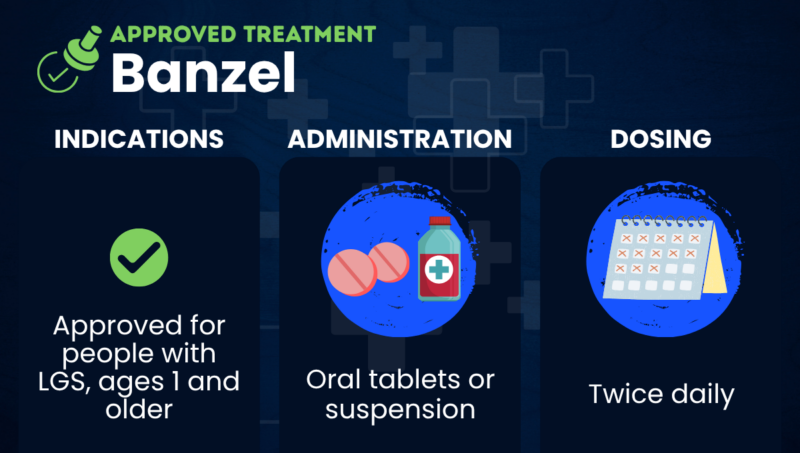
| Administration | Oral tablets or suspension |
Who can take Banzel?
Banzel is approved in the U.S. for the adjunctive treatment of seizures in adults and children with LGS, ages 1 and older. It also has approvals for LGS in the EU and Canada, although specific indications vary.
Banzel is contraindicated, or should not be used, by people with familial short QT syndrome, an inherited condition that affects heart rhythms. It is also not recommended for people with severe liver impairments.
How is Banzel administered?
Banzel is taken as oral tablets or a liquid oral suspension, twice daily, with food. The recommended dosing is based on age:
- Children: Dosing is weight-based, starting at 10 mg/kg daily, divided into two equal doses. This can be gradually increased to 45 mg/kg per day, with a maximum of 3,200 mg per day.
- Adults: The starting dose is 400 mg to 800 mg per day, divided into two equal doses. The dose can be gradually increased to a maximum of 3,200 mg per day.
The tablets can be swallowed whole, cut in half, or crushed. The oral suspension should be measured out using the provided dosing syringe.
Dose adjustments may be needed for people who are using the anti-seizure medication valproate, and those with kidney impairments requiring dialysis.
Banzel in clinical trials
Banzel’s approval for LGS was supported by data from two clinical trials. Both studies involved people with LGS whose seizures were not adequately controlled with existing medications.
- Adults and children ages 4 and older: A placebo-controlled Phase 3 trial showed that the monthly frequency of total seizures and drop seizures — seizures that cause a person to fall to the ground — was significantly reduced with Banzel. Caregiver-reported reductions in seizure severity were greater with Banzel than with a placebo.
- Children ages 1 to 3: An open-label Phase 3 study (NCT01405053) showed that the therapy was safe for use in younger children and that its pharmacological properties were not affected by age.
Banzel side effects
The most common side effects of Banzel include:
- headache
- dizziness
- fatigue
- drowsiness
- nausea
Banzel also comes with warnings for potentially serious adverse events that require careful monitoring, including:
- suicidal thoughts or behaviors
- neurological complications, including drowsiness, dizziness, and movement changes
- heart rhythm abnormalities
- severe, multi-organ immune reactions (hypersensitivity)
- reduced numbers of white blood cells
If these events occur, Banzel may need to be discontinued or the dose adjusted, depending on the situation.
Banzel could reduce the effectiveness of hormonal contraceptives, so individuals should use additional, non-hormonal forms of contraception while on the medication. Banzel may also interact with other medications, including anti-seizure drugs. Doctors should be made aware of all other medications being used.
When discontinuing Banzel, the dose should be gradually decreased to minimize the risk of increased seizure frequency or a medical emergency known as status epilepticus.
Lennox-Gastaut Syndrome News is strictly a news and information website about the disease. It does not provide medical advice, diagnosis, or treatment. This content is not intended to be a substitute for professional medical advice, diagnosis, or treatment. Always seek the advice of your physician or other qualified health provider with any questions you may have regarding a medical condition. Never disregard professional medical advice or delay in seeking it because of something you have read on this website.