Clobazam for Lennox-Gastaut syndrome
 Fact-checked by
What is clobazam for Lennox-Gastaut syndrome?
Clobazam is an approved medication used as an add-on therapy for managing seizures in people with Lennox-Gastaut syndrome (LGS).
It belongs to a class of treatments called benzodiazepines, which affect calming signals in the brain to help reduce the excessive nerve cell firing that drives seizures. In contrast to some other medications in its class, clobazam was developed to have more selective anticonvulsant effects with fewer benzodiazepine-related side effects.
In the U.S., clobazam is available as oral tablets and an oral suspension under the brand name Onfi, marketed by Lundbeck. It is also available as Sympazan, an oral film formulation that dissolves on the tongue; Cosette Pharmaceuticals holds U.S. sales and distribution rights for Sympazan. Generic versions of clobazam are also available as tablets and an oral suspension. Clobazam is marketed in other countries as well, although brand names may vary.
Therapy snapshot
| Brand name | Onfi, Sympazan |
| Chemical name | Clobazam |
| Usage | Used as an add-on to manage seizures in LGS |
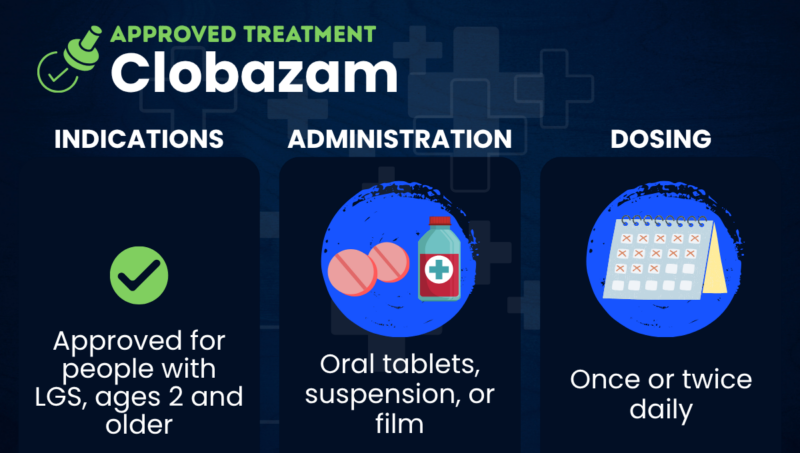
| Administration | Oral tablets, suspension, or film |
Who can take clobazam?
In the U.S., clobazam is approved for the adjunctive treatment of seizures in people with LGS, ages 2 and older.
It is contraindicated, or should not be used, in people with a history of hypersensitivity reactions to clobazam or any of its ingredients.
Clobazam also comes with a boxed warning noting serious risks associated with the use of benzodiazepines, including:
- sedation, suppressed breathing, coma, or death when used with opioids
- abuse, misuse, and addiction, which can lead to overdose or death
- withdrawal reactions with abrupt discontinuation or dose reduction
How is clobazam administered?
Clobazam may be taken as oral tablets, an oral suspension, or an oral film. The recommended dosing is weight-based:
- patients weighing 30 kg (about 66 pounds) or less: start at 5 mg daily, with the dose gradually increased up to 20 mg daily as tolerated
- patients weighing more than 30 kg: start at 10 mg daily, with the dose gradually increased up to 40 mg daily as tolerated
Any doses above 5 mg/day should be split into two smaller doses. Dose adjustments may be needed for older adults, people with low CYP2C19 enzyme activity, or those with liver impairment.
Tablets can be swallowed whole, broken in half, or crushed and mixed in applesauce. The liquid suspension should be measured out using the provided syringe. The oral film is placed directly on the top of the tongue, where it will stick and dissolve.
Clobazam can be taken with or without food, but the oral film should not be taken with liquid.
Clobazam in clinical trials
The approval of clobazam for LGS was supported by two controlled clinical trials that tested the oral tablet formulation:
- The Phase 3 CONTAIN trial (NCT00518713) involved 238 people with LGS, ages 2 to 54. The results showed that all tested doses of clobazam led to significant reductions in the weekly frequency of drop seizures — seizures characterized by a loss of muscle control and falling down — relative to a placebo. Physician- and caregiver-reported assessments indicated clobazam significantly improved symptoms.
- A smaller Phase 2 trial (NCT00162981) involved 68 people with LGS, ages 2 to 25. The results showed that both a low and a high dose of clobazam significantly reduced weekly drop seizure frequency, with greater effects seen with the higher dose.
Approvals of the oral liquid suspension and oral film formulations were also supported by bioavailability or bioequivalence studies showing they had similar effects in the body as clobazam tablets, and would thus be expected to have similar safety and efficacy profiles.
Clobazam side effects
The most common side effects of clobazam include:
- constipation
- drowsiness or sedation
- fever
- lethargy
- drooling
According to the boxed warning, clobazam should not be combined with opioid medications unless there are no adequate alternative options because of the risk of life-threatening complications. If they must be used together, the dose and duration should be kept to a minimum, with close monitoring.
Abuse or misuse of clobazam increases the risk of serious complications or death, especially when combined with other medications, alcohol, or illicit substances. Patients should be monitored for signs of medication misuse.
The continued use of clobazam can result in physical dependence, especially with longer treatment and higher doses. Abruptly stopping clobazam can cause life-threatening withdrawal reactions, so the dose must be gradually tapered.
All formulations of clobazam come with warnings for other potentially serious side effects, including:
- drowsiness or sedation that impairs daily function, especially when combined with alcohol or other drugs that suppress the nervous system
- serious skin reactions
- multiorgan hypersensitivity reactions
- suicidal thoughts or behaviors
Patients should be closely monitored for these events; if they occur, treatment may need to be discontinued.
Clobazam may interact unsafely with alcohol and other medications. Doctors should be aware of all medications, supplements, alcohol, or other substances patients are using. Clobazam could reduce the effectiveness of hormonal contraceptives; additional non-hormonal forms of birth control are recommended.
Use of clobazam late in pregnancy can result in sedation or withdrawal symptoms in newborns. Patients should alert their care team if they are pregnant.
Lennox-Gastaut Syndrome News is strictly a news and information website about the disease. It does not provide medical advice, diagnosis, or treatment. This content is not intended to be a substitute for professional medical advice, diagnosis, or treatment. Always seek the advice of your physician or other qualified health provider with any questions you may have regarding a medical condition. Never disregard professional medical advice or delay in seeking it because of something you have read on this website.